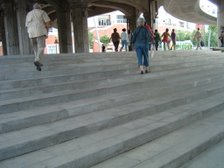
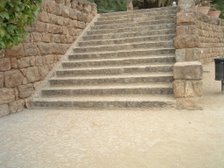
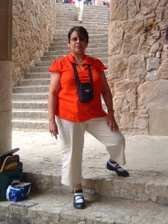
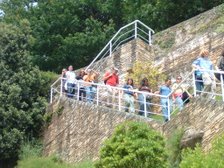
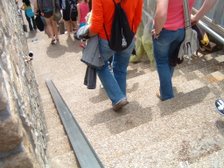
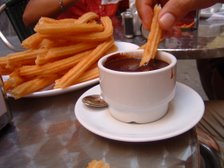
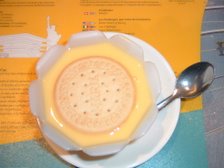
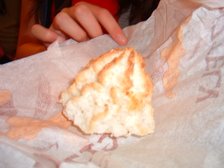
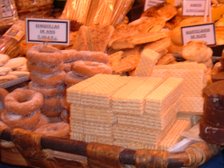
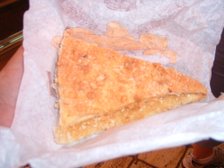
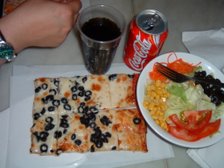
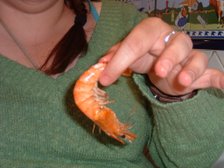
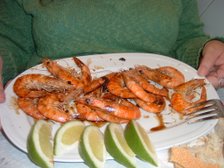
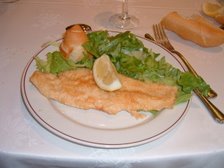
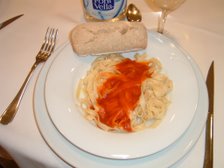
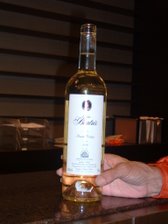
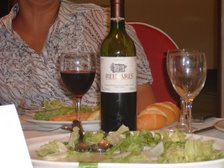
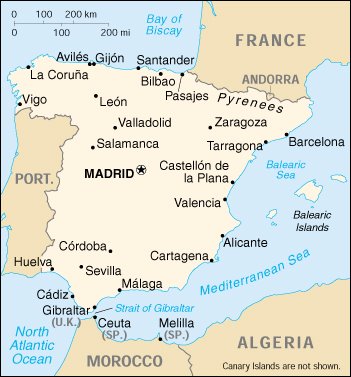
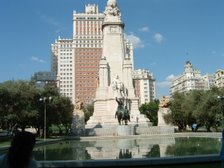
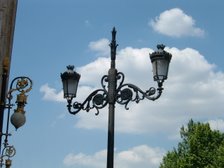
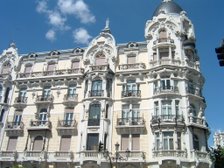
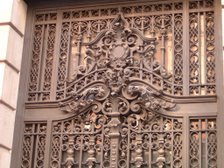
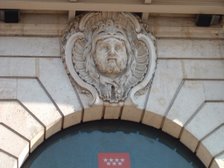
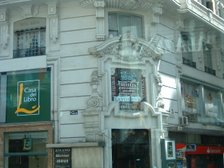
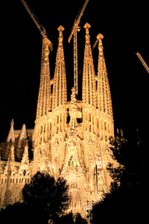
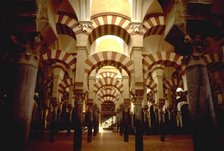
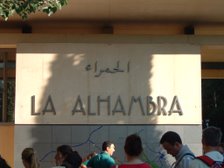
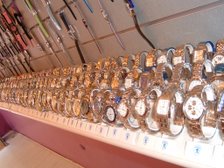
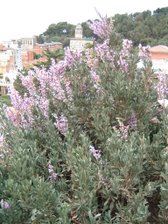
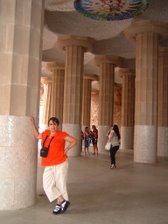
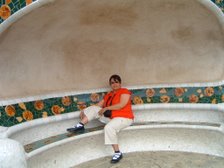
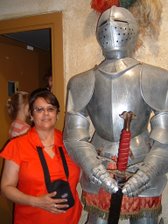
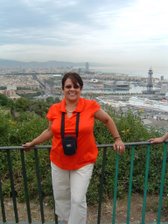
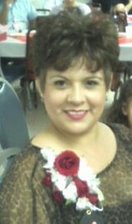
Walking down the main streets of Barcelona, you can hear the people taking. You may hear conversations you wish not to hear, but then you may overhear some tips for shopping.
Monday, June 18, 2007
Saturday, June 16, 2007
San Sebastian, Spain
San Sebastian is a beautiful city with walkways, large bridges, sandy beaches, tall buildings and narrow streets. Picture to the right Me on the bridge.
History of San Sebastian
The city of San Sebastian was founded around 1180 by the King Sancho el Mayor of Navarra (called Sancho el Fuerte-Sancho the Strong).
One of the most notable wars was in the 18th century between the English and the French (179 – 1721). The French occupied San Sebastian, however, they finally withdrew after the signing of the Hague peace treaty. There was peace until 1808.
Their buildings are incredible. Picture a building whose front forms a triangle with a street on each side leading of to a great distance. I saw so many of these types of buildings. 
The streets are adorned with trees that are decorations with chilies and fruits.
Pictures by Marsha J. P. Gonzales

Pictures by Marsha J. P. Gonzales
I love this city! I want to visit again with my family!
History of San Sebastian
The city of San Sebastian was founded around 1180 by the King Sancho el Mayor of Navarra (called Sancho el Fuerte-Sancho the Strong).
One of the most notable wars was in the 18th century between the English and the French (179 – 1721). The French occupied San Sebastian, however, they finally withdrew after the signing of the Hague peace treaty. There was peace until 1808.
Napoleonic troops invaded San Sebastian and on August 31, 1813 there was a huge explosion and a great fire that destroyed the city. The city was rebuilt following the destruction. The city was a military stronghold.
Nevertheless, today there remains no exceedingly old buildings because of the fires suffered through the ages according to World Facts Index Spain. However, there is the post-16th century era Iglesia de San Vicente (Saint Vincent Church) the church of Santa Maria and the convent of San Telmo. Also some remains of the city wall can be seen.
Thursday, June 14, 2007
Third day. From Madrid to Burgos
I am sitting in Burgos, Spain, at the quaint Crispains (cyber café). Now this is what I call a cyber café. You can order coffee or a drink and smoke a cigarette or two while waiting for a computer!
Four hours from Madrid to Burgos
On our four hour bus trip from Madrid to Burgos I saw the most beautiful scenery…rows and rows of bushes of yellow flowers! The country roads are lined with them. Hills after hills with beautiful lush vegetation can be seen for miles. Now I cannot forget to include the one-sided solid rock hills that extended for miles. What is so interesting about these hills is that on the rock side there is no vegetation. On the back side of the rock hills, they become hills of lush vegetation.
Why should U. S. citizens care?
During my brief stay in Madrid, the air was so pure and clean.
I was told by our guide, Gary, that Spain uses bio fuel.
Why should U. S. citizens care?
Bio fuel causes less air pollution, therefore cleaner fresher air for us to breath. In the United States Bio energy is not commonly used. The uses of bio fuel in the U.S. over time could aid in fewer people with respiratory problems.
Trees are everywhere in the city of Madrid. They line the parks and the town square.
Why should U. S. citizens care?
The city has an abundance of shade. You can walk in the cool shade of the trees. Believe me in Spain you walk for miles. Sure you can take the subway, but guest what! You have to walk to the subway. Then you have to descend three flights of steep stairs just to get on the subway. Sure there are the escalators. Spaniards do not just stand and enjoy the escalator ride, NO, they walk the escalator. They walk it at almost a running pace. After you have taken the subway you walk some more. Believe me you want to be in the cool shade. The U. S. should stop cutting down so many trees and invest in more trees. Trees are beautiful and produce our much-needed oxygen. With more shade in our cities it could reduce our chance of getting skin cancer.
Interesting facts about Spain
Vehicles are driven on the same side of the road as in the United States. Drivers sit on the left side of the car.

Sidewalks and roads are made of bricks or cobble stone. Often, it is hard to tell the sidewalk from the road.
Pictures by Marsha J. P. Gonzales
The corner traffic walk signal, we were told by are guide, RED MAN if you value your life DO NOT walk. GREEN MAN walk, GREEN FLASHING MAN run for your life. This was quite amusing. Our guide, Gary, can be quite funny at times.
Four hours from Madrid to Burgos
On our four hour bus trip from Madrid to Burgos I saw the most beautiful scenery…rows and rows of bushes of yellow flowers! The country roads are lined with them. Hills after hills with beautiful lush vegetation can be seen for miles. Now I cannot forget to include the one-sided solid rock hills that extended for miles. What is so interesting about these hills is that on the rock side there is no vegetation. On the back side of the rock hills, they become hills of lush vegetation.
Why should U. S. citizens care?
During my brief stay in Madrid, the air was so pure and clean.
I was told by our guide, Gary, that Spain uses bio fuel.
Why should U. S. citizens care?
Bio fuel causes less air pollution, therefore cleaner fresher air for us to breath. In the United States Bio energy is not commonly used. The uses of bio fuel in the U.S. over time could aid in fewer people with respiratory problems.
Trees are everywhere in the city of Madrid. They line the parks and the town square.
Why should U. S. citizens care?
The city has an abundance of shade. You can walk in the cool shade of the trees. Believe me in Spain you walk for miles. Sure you can take the subway, but guest what! You have to walk to the subway. Then you have to descend three flights of steep stairs just to get on the subway. Sure there are the escalators. Spaniards do not just stand and enjoy the escalator ride, NO, they walk the escalator. They walk it at almost a running pace. After you have taken the subway you walk some more. Believe me you want to be in the cool shade. The U. S. should stop cutting down so many trees and invest in more trees. Trees are beautiful and produce our much-needed oxygen. With more shade in our cities it could reduce our chance of getting skin cancer.
Interesting facts about Spain
Vehicles are driven on the same side of the road as in the United States. Drivers sit on the left side of the car.
Sidewalks and roads are made of bricks or cobble stone. Often, it is hard to tell the sidewalk from the road.
Pictures by Marsha J. P. Gonzales
The corner traffic walk signal, we were told by are guide, RED MAN if you value your life DO NOT walk. GREEN MAN walk, GREEN FLASHING MAN run for your life. This was quite amusing. Our guide, Gary, can be quite funny at times.
Wednesday, June 13, 2007
Second Day in Madrid
Today is a free day! We were up by 7 a.m. off to a wonderful breakfast. So many dishes! Can you believe it, walnut, for breakfast! There were all kinds of fruits, cheeses, cakes, cookies, hams, minie hot dogs, eggs, and sauces. Now the coffee is to die for! Fresh squeezed orange juice.
Off to a leisure stroll down to Museo Nacional del Prado. Stroll did I say stroll? We braved the subway! The Museo housed so many wonderful artists´ works. In the gallery of Francisco Calvo Serraller artist Diego Velazquez, who we studied about in Art Appreciation, oil on canvas (318 X 276 cm) masterpiece ¨Las Meninas¨ (The Family of Philip IV) was even more breathtaking to see in person!

Web pictures
The gallery Goya Manuela B. Mena Marques the oil in the execution on Principe Pio Hill, that comes to mind is The Third of May 1808 in Madrid.
Off to a leisure stroll down to Museo Nacional del Prado. Stroll did I say stroll? We braved the subway! The Museo housed so many wonderful artists´ works. In the gallery of Francisco Calvo Serraller artist Diego Velazquez, who we studied about in Art Appreciation, oil on canvas (318 X 276 cm) masterpiece ¨Las Meninas¨ (The Family of Philip IV) was even more breathtaking to see in person!

The painting depicts a small child in a elegant gown. In the background the image of the King and Queen, whose physical position would coincide with that of the viewer, can be seen in a mirror displayed on the wall. This oil painting is a great conversational piece.
Web pictures
The gallery Goya Manuela B. Mena Marques the oil in the execution on Principe Pio Hill, that comes to mind is The Third of May 1808 in Madrid.

This oil art work is one well know to Spaniards. It records the French army’s cruel repression of the Spanish. There is a lantern on the ground in the center of the painting the light is focused on those who are about to be killed. Their faces depict terror. The light illuminates three dead bodies whose blood spills from their lifeless bodies.
There is so much we saw today, and I have very little time to put it in writing. I am leaving in just a few seconds to view a live performance of the passionate and seductive art form of Spain’s flamenco dancing. My wish has come true!
I have to leave, or I will miss the performance.
Tuesday, June 12, 2007
My first day in Spain
picture by Marsha J. P. Gonzales
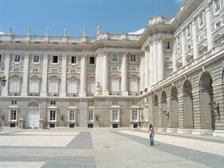
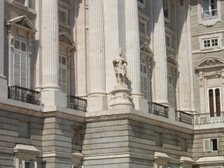
Hi, everyone, today was a very fast-paced day. We visited the Palacio Real de Madrid. This palace is huge! It is a complete rectangle. The picture above is only one segment of one side. It houses several royal collections of great historical value. It is the official residence of the King of Spain. The King does not live in the palace. He uses the palace for official ceremonies and entertaining.
The palace dates back to the 9th century. The Islamic Kingdom of Toledo built it as a fortress, which was later used by the Kings of Castile. In the 16th century the Old Alcazar was constructed. It was later destroyed by fire on Christmas Eve, 1734.
Picture by Marsha J. P. Gonzales
picture by Marsha J. P. Gonzales
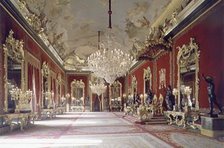
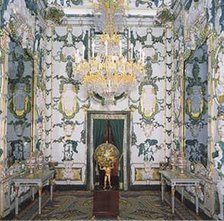
Within the palacio´s walls we were able to view only 20 rooms. One room was called Salon De Columnas. Within the wall were mounted 12 large mirrors trimmed with gold and two angels on the upper top and one in the middle. The ceiling was covered with fresco paintings.
I saw the King’s Throne Room!

Web picture
The ceiling was covered with an unbelievable fresco that stretched the total length and width of the ceiling. Depicted in the fresco is the Allegory of the Spanish Monarchy. This fresco was painted by Tiepolo and completed in 1766. Twelve huge golden mirrors lined the walls. They are from the Royal Factory of La Granja. Under each mirror was a large golden wall table. The floor was covered with a gorgeous red, green, and gold patterned carpet. Hanging from the ceiling were two huge rock-crystal chandeliers that illumined the room. The chandeliers were purchased by Venice in 1780. In the center of the room to the left are the two stunning golden thrones. Leading to the throne are four side to side long steps covered with red carpet. Four large bronze lions sit on the two sides of the platform in front of the thorn. The lions are resting their paws on large golden globes, as to protect the king and queen. These lions represent power. They were brought from Rome in 1650 by Velazquez. In this majestic room, the king’s subjects are allowed to see the king.
Interesting fact:
The city of Madrid is in a triangular shape. From kilometre 0 in the La Puerta del sol all ends met.
Saturday, June 9, 2007
Introduction to Medieval Spain.
It is almost time to depart for Spain, just two more days! I am so excited! I have learned so many new tips for traveling abroad. One major tip, straight from the bank, is to wrap all credit cards each in a small piece of foil then place them back in their little envelopes. Why? The magnetic field can be erased. When you get to the airport and you are putting your items on the conveyer belt, personally hand your card or cards to the attendant so they can see they are just your cards.

Web pictures
In Spain, there is a medieval city named Roman Toletum (Toledo), which sits on a large hill encircled by granite rock and sheer cliffs with its three sides facing the Tagus River.

Web pictures
In Spain, there is a medieval city named Roman Toletum (Toledo), which sits on a large hill encircled by granite rock and sheer cliffs with its three sides facing the Tagus River.
The city was constructed with gates that opened into a zigzagged open air hall, thus making the invaders easy targets once they entered the air hall. The Visigoths (or West Goths) chose this site as their capital city because it was a perfect stronghold.
What I find interesting is out of thirty-four kings, only fifteen died of natural causes. One king in particular Sigeric had King Atawulf killed. Just one week later he was killed by the hand of Walia. Today Visigothic remnants are felt in Toledo and in Spain.
It is said “Gothic accomplishments in Spain proved inconsequential” The Story of Spain (pg 51). The people herded animals. They gave us the horseshoe arch.
A few dozen Gothic words entered both English and Spanish, a few are listed below:
werra (war/Guerra), ratubon (to rob/robar), helm,(helmet/yelma), harpa (harp/arpa).
Their wise chose of location made them a source of political power. Nevertheless they were barbarians who could not unify and this proved to be their downfall. Spain had become “different” for the first time. The Goths sported long locks and gaudy jewelry. They were primitive and warlike with harsh laws. They later begin to combine Goth with Hispanic styles and customs losing their customs and idealism.
One interesting fact stated in The Story of Spain chapter three, is the word “Gothic” with came to mean “barbaric and uncouth,” the Renaissance architects who loved the classical style, disliked the late-medieval cathedrals calling them ugly, in other words gothic. Today the name remains.
Another interesting fact stated: “Within the wall of the city of Toledo, King Roderick deflowered the lovely daughter [of] count [Julian],” the Byzantine governor of Septum (Ceuta) on the African side of the strait, whose vengeance brought the Moors to Spain” (pg 50).
Once the Moors invaded they changed Spain forever. The word Moors can be used to refer to all Muslims –whether Berber or Arab—who conquered the Iberian Peninsula, as stated in the book.
This was the period where a new religion invaded Spain and many became Muslims. When the followers of Moors invaded Spain, they brought no women, thus a second generation was born half Hispanic.
The Moors harems were large, housing many beautiful women. Fair women from the north were favored, resulting in interbreeding, producing a race of leaders in which Arab blood became insignificant as stated on page 63. These new rulers were proud of their Arab blood and would dye their hair black so they could appear more Arabic.
The Moors' left their mark on Spain with their patios, gardens, fountains, and palaces. The Great Mosque, the second most important place of worship in the Muslim world after Mecca is their greatest legacy. They had hundreds of public baths. They improved on Roman irrigation. Moors made numerous contributions to Spain. They brought over Arabian horses. They introduced new crops such as apricot, fig, lemon, orange, peach, and pomegranate, as well as cotton, rice, saffron, sugar cane, and silk.
It is said “Gothic accomplishments in Spain proved inconsequential” The Story of Spain (pg 51). The people herded animals. They gave us the horseshoe arch.
A few dozen Gothic words entered both English and Spanish, a few are listed below:
werra (war/Guerra), ratubon (to rob/robar), helm,(helmet/yelma), harpa (harp/arpa).
Their wise chose of location made them a source of political power. Nevertheless they were barbarians who could not unify and this proved to be their downfall. Spain had become “different” for the first time. The Goths sported long locks and gaudy jewelry. They were primitive and warlike with harsh laws. They later begin to combine Goth with Hispanic styles and customs losing their customs and idealism.
One interesting fact stated in The Story of Spain chapter three, is the word “Gothic” with came to mean “barbaric and uncouth,” the Renaissance architects who loved the classical style, disliked the late-medieval cathedrals calling them ugly, in other words gothic. Today the name remains.
Another interesting fact stated: “Within the wall of the city of Toledo, King Roderick deflowered the lovely daughter [of] count [Julian],” the Byzantine governor of Septum (Ceuta) on the African side of the strait, whose vengeance brought the Moors to Spain” (pg 50).
Once the Moors invaded they changed Spain forever. The word Moors can be used to refer to all Muslims –whether Berber or Arab—who conquered the Iberian Peninsula, as stated in the book.
This was the period where a new religion invaded Spain and many became Muslims. When the followers of Moors invaded Spain, they brought no women, thus a second generation was born half Hispanic.
The Moors harems were large, housing many beautiful women. Fair women from the north were favored, resulting in interbreeding, producing a race of leaders in which Arab blood became insignificant as stated on page 63. These new rulers were proud of their Arab blood and would dye their hair black so they could appear more Arabic.
The Moors' left their mark on Spain with their patios, gardens, fountains, and palaces. The Great Mosque, the second most important place of worship in the Muslim world after Mecca is their greatest legacy. They had hundreds of public baths. They improved on Roman irrigation. Moors made numerous contributions to Spain. They brought over Arabian horses. They introduced new crops such as apricot, fig, lemon, orange, peach, and pomegranate, as well as cotton, rice, saffron, sugar cane, and silk.
Friday, June 8, 2007
Influences on the Iberian Peninsula
The bridge between two continents and two seas is the Iberian Peninsula. Migrants, traders, colonizers, and conquerors all passed through leaving traces of their society.
The first to migrant into the Iberian Peninsula were the Iberians. They were believed to have come from North Africa in the third millennium B. C., but their origin in not certain. They were dark skinned sporting long hair. They lived in small settlements on the hilltops and lived along the coast as farmers, fishermen, or merchants isolated from other tribes. Their diet was mostly fish and olive oil. They loved wine they even mixed wine with honey. Iberians mined silver, created works of bronze and iron. Their contribution was agricultural and metallurgical. It is said that Iberians could endure hardships and pain more then any other society. The Iberians were argumentative people, dedicated to bulls, and horses.
They disliked organization for they were individualistic. Therefore, they were suspicious of all strangers. Superstition was evident in their religion and they had great respect for their elders.
Iberians communicated orally they had no written language. Nevertheless, they later adopted the Phoenician alphabet. Their language can be linked to the Basque language. Basque is an exceptionally difficult, complex language. “Some romantics believe it was the language spoken by Adam and Eve in the Garden of Eden” as stated in The Story of Spain. It is believed that God condemned the devil to learn Basque because of his contemptible transgression.
The second race to settle on the peninsula of Iberia was the purely indigenous Celtics in the ninth and seventh centuries B. C. They intermarried with the Iberians creating a new race called Celtiberians. The Celtics spread over about two-thirds of the peninsula inhabiting meseta and most of the north and west. They studied the properties of metals and were experts in extracting and refining alloy and creating exceptional works of art. One of their creations is the short broad sword, which can be seen in museums today. They were shepherds by nature and introduced the custom of wearing trousers. They had an unusual custom of placing their sick along the roadside in the hopes any one passing would aid the ailing. It was the custom of the Celtics to burn their dead.
The Phoenicians were the third race to settle on the peninsula competing to control Spain’s coastline and resources. Some of their features were dark skin, wide foreheads, high cheekbones, and hooked noses. They were in the trading and fishing industry. They brought Middle Eastern culture and advance Mediterranean civilization to the peninsula. One of the main influences in society was their alphabet that consists of 22 characters. Their alphabet influenced the Ancient Greek and Hebrew alphabets. We now use their S shape that has two lines running down as our dollar sign. Some of the Phoenician artifacts that remain today are alabaster jars with names of Egyptian pharaohs and decorated ostrich eggs. They brought with them their advance Mediterranean civilization.
One of the greatest civilizations in history is located in central Italy that civilization is Rome. Rome ruled the Iberian Peninsula, which they called Hispania Rome. They are known for their army, Christianity, architecture, and entertainment. Their army destroyed their enemy mercilessly and uses them for violent sport. They spread Christianity through the land. They brought cultural to the peninsula. Romans contribution to Spain was their language, architectural and their engineering principles that are still used today. They built roads, bridges and aqueducts.
Web pictures
To the right is a view of the aqueduct.

To the left is a detail view of the aqueduct.
Rome rule lasted six centuries. They came across war nature natives who seemed to live for battle. Rome’s army was annihilated at Cannae, members of the senate were killed heads were lost. It took two centuries and more than 150,000 live to hold back the peninsula.
The first to migrant into the Iberian Peninsula were the Iberians. They were believed to have come from North Africa in the third millennium B. C., but their origin in not certain. They were dark skinned sporting long hair. They lived in small settlements on the hilltops and lived along the coast as farmers, fishermen, or merchants isolated from other tribes. Their diet was mostly fish and olive oil. They loved wine they even mixed wine with honey. Iberians mined silver, created works of bronze and iron. Their contribution was agricultural and metallurgical. It is said that Iberians could endure hardships and pain more then any other society. The Iberians were argumentative people, dedicated to bulls, and horses.
They disliked organization for they were individualistic. Therefore, they were suspicious of all strangers. Superstition was evident in their religion and they had great respect for their elders.
Iberians communicated orally they had no written language. Nevertheless, they later adopted the Phoenician alphabet. Their language can be linked to the Basque language. Basque is an exceptionally difficult, complex language. “Some romantics believe it was the language spoken by Adam and Eve in the Garden of Eden” as stated in The Story of Spain. It is believed that God condemned the devil to learn Basque because of his contemptible transgression.
The second race to settle on the peninsula of Iberia was the purely indigenous Celtics in the ninth and seventh centuries B. C. They intermarried with the Iberians creating a new race called Celtiberians. The Celtics spread over about two-thirds of the peninsula inhabiting meseta and most of the north and west. They studied the properties of metals and were experts in extracting and refining alloy and creating exceptional works of art. One of their creations is the short broad sword, which can be seen in museums today. They were shepherds by nature and introduced the custom of wearing trousers. They had an unusual custom of placing their sick along the roadside in the hopes any one passing would aid the ailing. It was the custom of the Celtics to burn their dead.
The Phoenicians were the third race to settle on the peninsula competing to control Spain’s coastline and resources. Some of their features were dark skin, wide foreheads, high cheekbones, and hooked noses. They were in the trading and fishing industry. They brought Middle Eastern culture and advance Mediterranean civilization to the peninsula. One of the main influences in society was their alphabet that consists of 22 characters. Their alphabet influenced the Ancient Greek and Hebrew alphabets. We now use their S shape that has two lines running down as our dollar sign. Some of the Phoenician artifacts that remain today are alabaster jars with names of Egyptian pharaohs and decorated ostrich eggs. They brought with them their advance Mediterranean civilization.
One of the greatest civilizations in history is located in central Italy that civilization is Rome. Rome ruled the Iberian Peninsula, which they called Hispania Rome. They are known for their army, Christianity, architecture, and entertainment. Their army destroyed their enemy mercilessly and uses them for violent sport. They spread Christianity through the land. They brought cultural to the peninsula. Romans contribution to Spain was their language, architectural and their engineering principles that are still used today. They built roads, bridges and aqueducts.
Web pictures
To the right is a view of the aqueduct.
To the left is a detail view of the aqueduct.
Rome rule lasted six centuries. They came across war nature natives who seemed to live for battle. Rome’s army was annihilated at Cannae, members of the senate were killed heads were lost. It took two centuries and more than 150,000 live to hold back the peninsula.
Thursday, June 7, 2007
June 6, 2007 Passport arrives in the nick of time!!!
Today is the 3rd day of class. We were introduced to Inverted pyramid style of writing. For those of you who do not know what this style is, it is writing the most newsworthy information first and the rest in descending order of importance. It sounds simple but it really hard to do at least for a first time news student as myself. We discussed our Tuesday’s homework assignment, writing four lead sentences. Our reading assignment consist of chapters 1, 2, and 9 of our The Art of Creative Nonfiction book. Today’s written assignment is to write a factual news article in the inverted pyramid style.
In the humanity part of class we are reading The Story of Spain. We discussed in class chapter two “The Romans Were Here.” Our assignment is to write at least 250 word essay on chapters 1-2.
This trip to Spain is going to more then having a lot of fun. It is going to be a lot of work, as I am finding out.
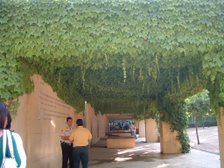
Now, the lighter side COUNT DOWN begins for me, why just now? I have finally received my U. S. PASSPORT!!! I was really getting worried. My passport is really beautiful. Each page pictures a historical U. S. monument.
In the humanity part of class we are reading The Story of Spain. We discussed in class chapter two “The Romans Were Here.” Our assignment is to write at least 250 word essay on chapters 1-2.
This trip to Spain is going to more then having a lot of fun. It is going to be a lot of work, as I am finding out.
Now, the lighter side COUNT DOWN begins for me, why just now? I have finally received my U. S. PASSPORT!!! I was really getting worried. My passport is really beautiful. Each page pictures a historical U. S. monument.
Wednesday, June 6, 2007
In my lifetime / My neighborhood
In my life time...I would like to report on and write about teenagers living in the computer age. I would like to know their views on having grown up with the internet, cell phone, PDA, laptops, and electronic games etc... It would be interesting to know their opinion about not having the advantages of the computer age.
As I enter my neighborhood, the street is silent. Four large black dogs patrol the corner of my street. The city street light that the neighborhood fought to have installed, shines over my driveway. My cream colored poodle (My Charlie) is howling for me to let him out of his chamber. Pretty Lucky, a rescue cat, eagerly awaits my appearance. All is quiet in my world.
When things settle down in the house and most of my assignments are complete and a good night call is made to my granddaughter, I slip away to visited my neighbor and best friend. We discuss the latest neighborhood news. Whether it is accounts of the high school children down the street or the elementary schools under construction, the news is delivered.
We are proud of the on-going construction of our Adams Elementary. Adams’s new playground and breeze ways are inviting. The interior of the building houses much-need up-to-date computer facilities. The neighborhood was in need of a new and improved elementary. Within the Harlandale District, two other elementary have been newly constructed on the same property as the previous elementary.
As I enter my neighborhood, the street is silent. Four large black dogs patrol the corner of my street. The city street light that the neighborhood fought to have installed, shines over my driveway. My cream colored poodle (My Charlie) is howling for me to let him out of his chamber. Pretty Lucky, a rescue cat, eagerly awaits my appearance. All is quiet in my world.
When things settle down in the house and most of my assignments are complete and a good night call is made to my granddaughter, I slip away to visited my neighbor and best friend. We discuss the latest neighborhood news. Whether it is accounts of the high school children down the street or the elementary schools under construction, the news is delivered.
We are proud of the on-going construction of our Adams Elementary. Adams’s new playground and breeze ways are inviting. The interior of the building houses much-need up-to-date computer facilities. The neighborhood was in need of a new and improved elementary. Within the Harlandale District, two other elementary have been newly constructed on the same property as the previous elementary.
Monday, June 4, 2007
A window into Spain's culture
An opportunity of a lifetime has opened up for me. That opportunity is to study and experience Spain’s culture.
I will be traveling with a group of 30 wonderful students and non-students along with two brilliant instructors. I have had the pleasure of studying Humanities with Ms. Marina Ornelas. I will now be studying World Cultures and Global Issues under her supervision. I am looking forwarded to studying under the guidance of Dr. Denise Barkis Richter, associde professor for of Communication and News Gathering/Writing I.
Studying in Spain will aid me in a multicultural environment. In the United State, since its very beginning, we have been a culturally diverse society. Today, large and small business organizations are no exception to multiculturalism. New leaders of today and tomorrow need to be educated in an array of cultures enabling them to understand the ideas, customs, values, and skills of a specific group of employees in all aspects of the job. Traveling to Spain will aid me in understanding the culture of Spain. I will be able to apply this new found awareness in a large organization who deals with business from Spain or who has a division in Spain.
The news gathering and writing course will enhance my written communication skill along with new techniques of information gathering. This course will provide me with basic knowledge of proper news story writing.
On the lighter side of my study abroad…I have often imagined the passionate and seductive art form of Spain’s flamenco dancing. I envisioned the dancers’ mysterious romantic movements to the fast pace of guitar. I dreamed one day I would see a live performance of flamenco that would take my breath away. My hope is to experience this dance live in Spain.
I am looking forward to new cultural experiences in Spain, including sampling the colorful cuisine of Spain. All my family and friends will understand my closing statement. I want to experience Spain to the fullest and treat my taste buds to that famous ice cream.
I will be traveling with a group of 30 wonderful students and non-students along with two brilliant instructors. I have had the pleasure of studying Humanities with Ms. Marina Ornelas. I will now be studying World Cultures and Global Issues under her supervision. I am looking forwarded to studying under the guidance of Dr. Denise Barkis Richter, associde professor for of Communication and News Gathering/Writing I.
Studying in Spain will aid me in a multicultural environment. In the United State, since its very beginning, we have been a culturally diverse society. Today, large and small business organizations are no exception to multiculturalism. New leaders of today and tomorrow need to be educated in an array of cultures enabling them to understand the ideas, customs, values, and skills of a specific group of employees in all aspects of the job. Traveling to Spain will aid me in understanding the culture of Spain. I will be able to apply this new found awareness in a large organization who deals with business from Spain or who has a division in Spain.
The news gathering and writing course will enhance my written communication skill along with new techniques of information gathering. This course will provide me with basic knowledge of proper news story writing.
On the lighter side of my study abroad…I have often imagined the passionate and seductive art form of Spain’s flamenco dancing. I envisioned the dancers’ mysterious romantic movements to the fast pace of guitar. I dreamed one day I would see a live performance of flamenco that would take my breath away. My hope is to experience this dance live in Spain.
I am looking forward to new cultural experiences in Spain, including sampling the colorful cuisine of Spain. All my family and friends will understand my closing statement. I want to experience Spain to the fullest and treat my taste buds to that famous ice cream.
Subscribe to:
Posts (Atom)